Where To Install This Alarm
Minimum coverage for Smoke Alarms, as recommended by the National Fire Protection Association (NFPA), is one Smoke Alarm on every floor, in every sleeping area, and in every bedroom.
For CO Alarms, the National Fire Protection Association (NFPA) recommends that a CO Alarm should be centrally located outside of each separate sleeping area in the immediate vicinity of the bedrooms. For added protection, install additional CO Alarms in each separate bedroom, and on every level of your home.
NOTE: For added protection, install an additional Smoke/CO Alarm at least 15 feet (4.6 meters) away from the furnace or fuel burning heat source where possible. In smaller homes or in manufactured homes where this distance cannot be maintained, install the Alarm as far away as possible from the furnace or other fuel burning source. Installing the Alarm closer than 15 feet (4.6 meters) will not harm the Alarm, but may increase the frequency of unwanted alarms.
Recommended Placement:
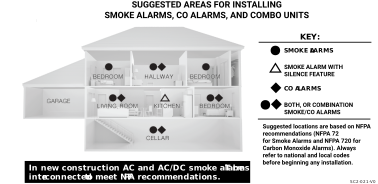
In General, Install Combination Smoke and Carbon Monoxide Alarms according to NFPA 72 recommendations:
FOR YOUR INFORMATION, THE NATIONAL FIRE ALARM AND SIGNALING CODE, NFPA 72, READS AS FOLLOWS:
29.8.1 *Required Smoke Detection
29.8.1.1 Where required by other governing laws, codes, or standards for a specific type of occupancy, approved single and multiple-station Smoke Alarms shall be installed as follows:
-
In all sleeping rooms and guest rooms
-
Outside of each separate dwelling unit sleeping area, within 21 ft (6.4 m) of any door to a sleeping room, with the distance measured along a path of travel
-
On every level of a dwelling unit, including basements
-
On every level of a residential board and care occupancy (small facility), including basements and excluding crawl spaces and unfinished attics
-
In living area(s) of a guest suite
-
In the living area(s) of a residential board and care occupancy (small facility)
(Reproduced with permission from NFPA 72® -2020, National Fire Alarm and Signaling Code® Copyright © 2019, National Fire Protection Association. This reprinted material is not the complete and official position of the NFPA on the referenced subject, which is represented only by the standard in its entirety which may be obtained through the NFPA website at www.nfpa.org.) (NFPA 72® and National Fire Alarm and Signaling Code® are registered trademarks of the National Fire Protection Association, Inc., Quincy, MA.)
In addition, adhere to the following:
-
In the hall near every sleeping area. If a hall is more than 40 feet (12 meters) long, install a unit at each end.
-
At the top of first-to-second floor stairs and at the bottom of the basement stairs.
-
For additional coverage, install Alarms in all rooms, halls, and storage areas, where temperatures normally remain between 40˚ F and 100˚ F (4.4˚ C and 37.8˚ C).
-
See Avoiding Dead Air Spaces for more information on proper placement on walls and ceilings.
NOTE: For any location, make sure no door or other obstruction could keep carbon monoxide or smoke from reaching the Alarm.
Installing Smoke/CO Alarms in Mobile Homes
For minimum security install one Smoke/CO Alarm as close to each sleeping area as possible. For more security, put one unit in each room. Many older mobile homes (especially those built before 1978) have little or no insulation. If your mobile home is not well insulated, or if you are unsure of the amount of insulation, it is important to install units on inside walls only.